
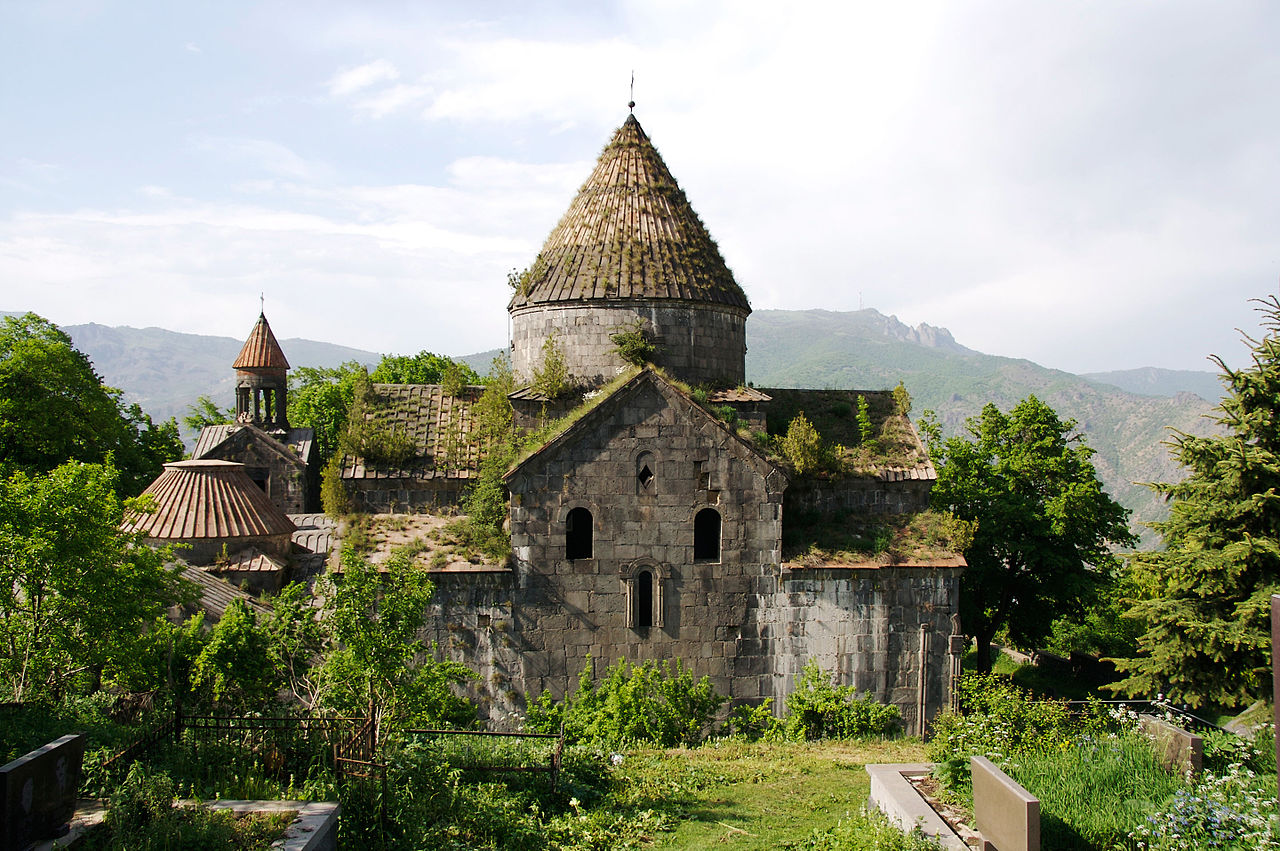
The Sanahin Monastery Complex is one of the mystical pearls of the medieval Armenian architecture. The elements of pagan temples of Armenia are preserved in the Sanahin Monastery complex to a greater extent than in other Armenian churches. The monastery was a major spiritual, scientific and cultural center of medieval Armenia and was built in the Gugark region of Historical Armenia (Sanahin district of Alaverdi town, the Lori region of the modern Republic of Armenia) on a mountain plateau, where the Dzoraget and Pambak rivers merge in the gorge, forming the Debed River.
The territory of the monastery makes about two hectares. The main temple of Sanahin, i.e. the Surb Astvatsatsin church, is located in the central part of the architectural ensemble of the monastery. The Surb Amenaprkich church, the Surb Grigor chapel, a book depository, the constructions of the Academy building, galleries, a vestibule, a bell tower, bridges and numerous auxiliary buildings are located nearby. According to an ancient custom associated with the cult of the sun, the main facade of the complex is turned to the west.
This also determined the construction on the western side of the main gates, through which pilgrims entered directly into the largest and front part of the courtyard. The first church of the monastery complex, i.e. the Surb Astvatsatsin Church, was built in the 30s of the 10th century during the reign of King Abas I Bagratuni. Surb Astvatsatsin is a sample of a cross-domed church built of basalt with four aisles oriented to the sides of light. Over the centuries, the church building has been subjected to repeated restorations and additional constructions, during the last of which the dome of the building has been added.
In 966, Ashot III the Merciful (Voghormats) and Queen Khosrovanush erected the Surb Amenaprkich Church (St. All-Savior) in honor of their sons Kyurike and Smbat and founded a Monastery and an Academy. The Academy was a major educational center: philosophy, calendrology, music, medicine, etc. were taught here besides theology. According to a legend, Grigor Magistros Pahlavuni taught here, and in his honor a gallery between the Surb Grigor and Surb Amenaprkich churches was named after him.
The Surb Amenaprkich Church significantly exceeds the Surb Astvatsatsin Church in terms of construction volume and is also a sample of a cross-domed church. A high relief image of the sons of Ashot III, i.e. Kings Smbat and Kyurike, is on one of the facades of the temple.
In 977, by the order of Smbat II, the Sanahin monastery became a residence of the bishop of the newly formed Kyurik kingdom, and Isaya headed the Tashir diocese.
The book depository of the Sanahin monastery complex and the Surb Grigor chapel (St. Gregory) were built during the period of abbess of Dioskoros of Sanahnetsi in the 11th century,
Not only ancient manuscripts and folios of ecclesiastical and secular content, but also church utensils necessary for worship were stored in the building of the book depository. The building of the book depository was projected and built in the form of a cubic volume with four columns supporting an octagonal tent. Lighting and ventilation of the building was carried out through a round opening in the upper part of the tent. The interior of the building has 10 openings-niches, differing in size, shape and purpose performing the function of cabinets.
Vestibules were attached to the churches from the western side, which served as an additional premise for worshipers, a tomb, a meeting place, sometimes church services were carried out in them.
In the 11th century. after the fall of the Kyurik kingdom and after the invasion of the Mongols, the monastery fell into decay and remained abandoned until the reign of the Zakarians. During the reign of the Zakarians, the monastery buildings were completely restored, and the famous Sanahin bridge was erected over the Debed River, along which there is a road leading to the monastery.
The bell tower of the monastery was built in the 13th century, it is the oldest of the bell towers that have come down to us. The first tier of the bell tower was used for storage purposes, the second tier, divided into three aisles, was used for religious purposes, the third tier was intended for restoration, correspondence and storage of books.
The architectural ensemble of Sanahin is especially interesting for a great number of memorial and commemorative cross-stones. The tombs of noble families of the end of the 10th century and the beginning of the 11th century, as well as chapels and a spring refer to other constructions of the monastery complex.
At the end of the 14th century, when the Zakaryans' Kingdom weakened and collapsed, the monastery and Sanahin village passed to the property of Argutyans-Dolgorukys, the descendants of the Zakaryans. During the years of the Soviet power, the church was in a list of cultural values being under special state protection.
