
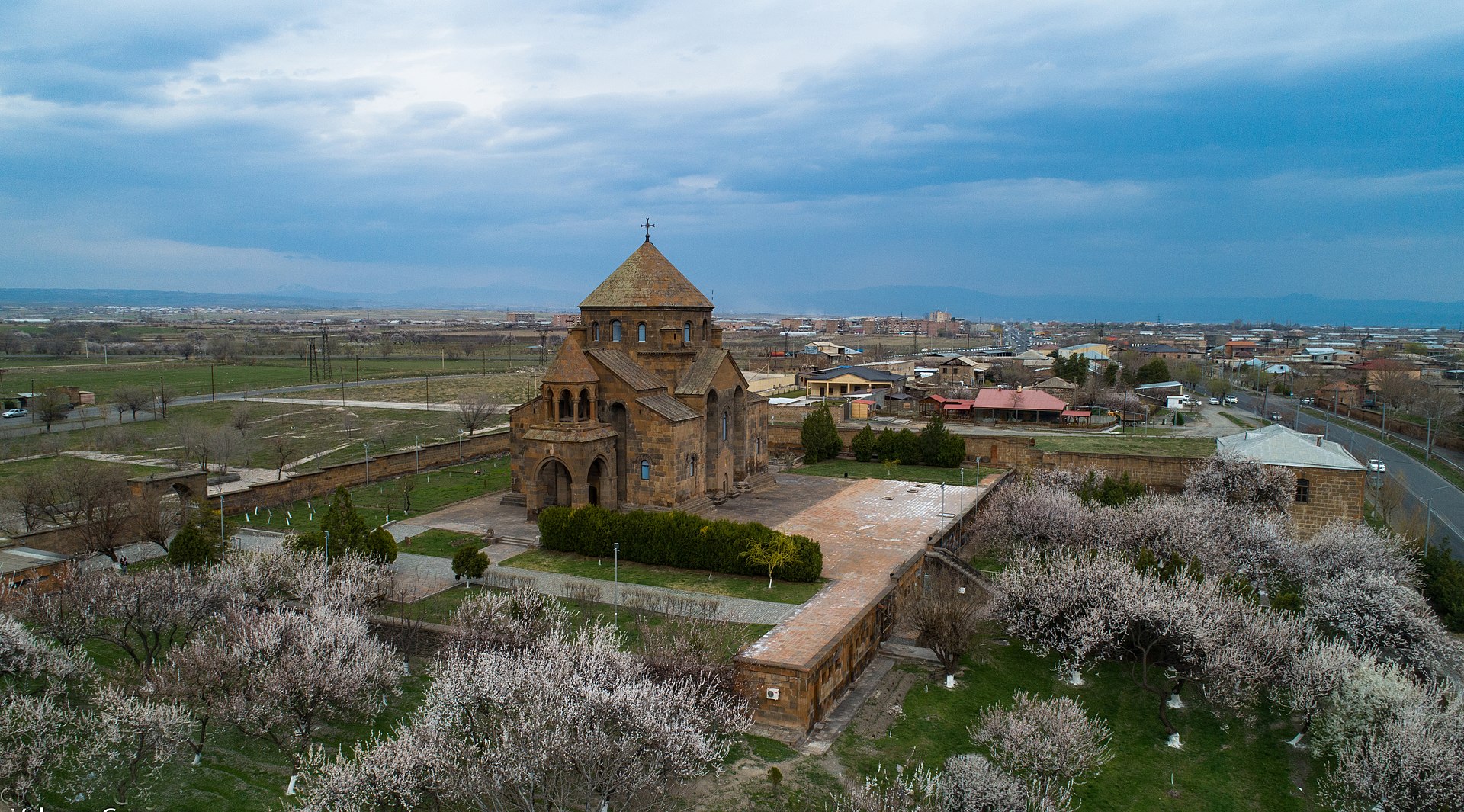
The Surb Hripsime Church is located in the north-eastern part of Etchmiadzin city. It was erected in the area of the martyrdom of saint Hripsime and her 32 friends. According to Agatangeghos, here in 301 Trdat III the Great, his sister Khosrovidukht and Queen Ashkhen erected a chapel and a tomb in the area indicated by Gregory the Illuminator.
In 395, Sahak Partev restored the chapel of Surb Hripsime destroyed by the Persian king Shapuh. According to Sebeos, a historian of the 7th century, in 618, Catholicos Komitas I Akhtsetsi demolished the chapel, which he considered to be low and dark, and in its place built the church of Surb Hripsime from hewn tuff, which stands up today. It is a central-domed structure, thanks to its perfect architecture, it can be called the best sample of churches which later received the name of Hripsime-shaped. The churches of Surb Hovhannes in Avan, Tsiranavor Surb Nshan in Aramus, Surb Astvatsatsin in Artsvaberd, Surb Khach of the Akhtamar Monastery and other churches are among them.
Catholicos Komitas left two inscriptions on the walls of the temple, in one of which he called himself a builder of the church. In the Armenian language of the early Middle Ages, the word "builder" was also used in the meaning of "architect", this means that Catholicos Komitas was also an architect of the church. In 628, the Catholicos died and was buried inside the church, opposite the tomb of Saint Hripsime.
At the beginning of XVII century the monastery was dilapidated and abandoned. According to Araqel Davrizhetsi, in those years the European missionaries, who came with the purpose of plundering of the treasures of Armenian culture and sanctities, destroyed the tomb and stole the relics of the saint. Later, the bishops of Etchmiadzin Grigor and Vardan achieved the return of the relics of the saint and restored the tomb. The graves of Catholicoses Astvatsatur I Hamadantsi and Karapet Ulnetsi are located in front of the western entrance to the church. The tombstones of the clergy serving here in XVII century are in the eastern part of the church.
Large stones with sculptural decorations in the Ionic style were found during the excavations. They, apparently, belonged to one of the pagan temples of ancient Vagharshapat. Their similar placement symbolized the victory of Christianity over paganism. The basement of the single-nave church of IV-V centuries was discovered near the church of Surb Hripsime during excavations in 1979, and an early medieval winepress was found behind the northern wall.
The church was restored in 1987.
