
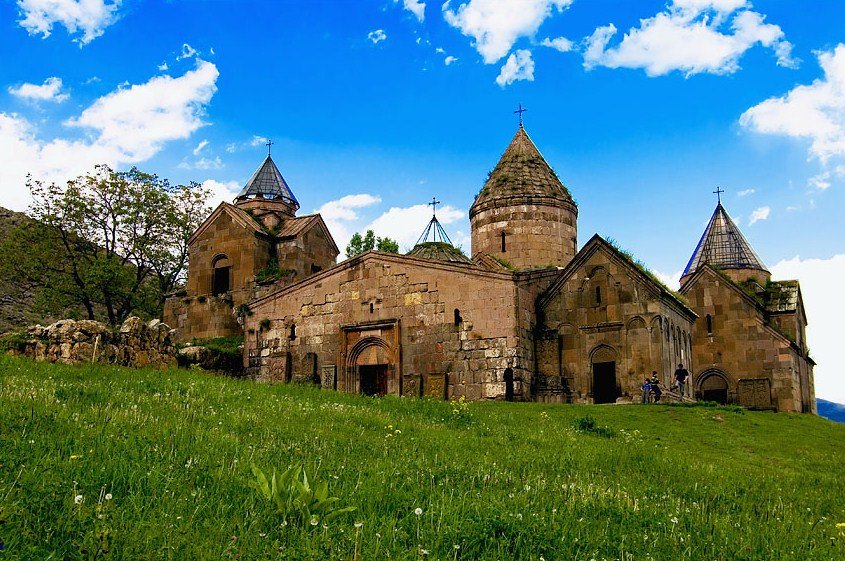
Gosh village of the Tavush region was founded in 1845. However, here there was a settlement as early as in the X-XII centuries.
The Goshavank Monastery is one of the largest spiritual and cultural centers of medieval Armenia. The monastery was founded by Mkhitar Gosh in 1188 with the assistance of Prince Ivane Zakaryan next to the Getik Monastery, which was destroyed by an earthquake.
The formation of the complex began in the XII century and lasted for a century. The monastery was considered as one of the most important educational centers of that time: such figures of medieval Armenia as Vardapet Vanakan and Kirakos Gandzaketsi were educated here. Initially, the monastery was called Nor Getik. After the death of Mkhitar Gosh the monastery was renamed Goshavank (Gosh Monastery) in his honor. Тwo churches were built here during the life of Mkhitar Gosh: the wooden church of Surb Lusavorich and Sur Hovhannu Karapet, which have not been preserved, as well as the Surb Astvatsatsin church with a vestibule.
According to Kirakos Gandzaketsi, during the consecration of the first church of Goshavank (the Surb Grigor church) the abbot of the Haghartsin Monastery Khachatur Taronatsi presented two villages and a garden to the monastery. The construction of the monastery continued until the end of the XIII century.
The monuments being part of the Nor Getik architectural complex are divided into two groups. The main group is located on the northern slope of a small gorge and consists of the Surb Astvatsatsin, Surb Lusavorich, Surb Grigor churches, a vestibule, a library-bell tower, civil constructions, chapels and khachkars. Two-altar church of Surb Hripsime and the ruins of the construction that is considered to be the tomb of Mkhitar Gosh are located to the south-east of this group, on the opposite slope of the gorge, at a short distance from each other.
The Surb Astvatsatsin Church was built by Vardapet Mkhitar Hyusn with the assistance of Princes Qurd and Vakhtang of Khachen. The church is cross-domed, two-tier, with two sacristies.
The vestibule (zhamatun) was built immediately after the main church with the assistance of brothers Zakare and Ivane. Its external and internal walls are not finished.
The Surb Grigor Church was built in 1241. It is similar to the main church, but yields it in its sizes.
The Surb Lusavorich Church is the third church of Goshavank, it is located at the southern wall of the vestibule. It was built at the expense of Prince Grigor Tkha. It is a single-nave church of the basilic type. It differs from other churches of the monastery by its external decoration, exquisite ornamentation and architectural elements.
The two-storey library-bell tower is a remarkable construction from an architectural point of view. There are storages for manuscripts on the internal walls of the library. The bell tower attached to the library harmoniously fits into the overall composition.
The Theological Seminary of Goshavank was known throughout Armenia. In the historical sources it is referred to as a university, an academy. Armenian and foreign languages, grammar, philosophy, architecture, music, the art of manuscripts' rewriting and painting were taught at the Goshavank Seminary. Manuscripts were created and rewritten in Goshavank; they were kept in the library of the monastery. Kirakos Gandzaketsi and Vardapet Vanakan, who worked in the monastery, continued the traditions of Goshavank in new schools founded by them.
Khachkars located on the territory of the monastery are an integral part of the monastery complex. The khachkars created by master Petros are distinguished amongthem by their craftsmanship and elegance of the composition.
There are no monastery walls here, the monastery is surrounded by village houses.
